
Career exploration
A changing world. Familiar choices.
We hear a great deal about how quickly the world of work is changing. New technology. New industries. Jobs appearing that most of us couldn’t have named when we were at school.
Yet, over the period from 2000-2022, the OECD’s 2025 report on teenage career preparation found that the career aspirations of 15-year-olds hadn’t changed much at all.
Asked what job they expected to have at around 30, teenagers named many of the same occupations as their teenage counterparts two decades earlier. Across the participating OECD countries, seven of the ten occupations most commonly named by girls appeared in both the 2000 and 2022 lists. For boys, it was nine out of ten.
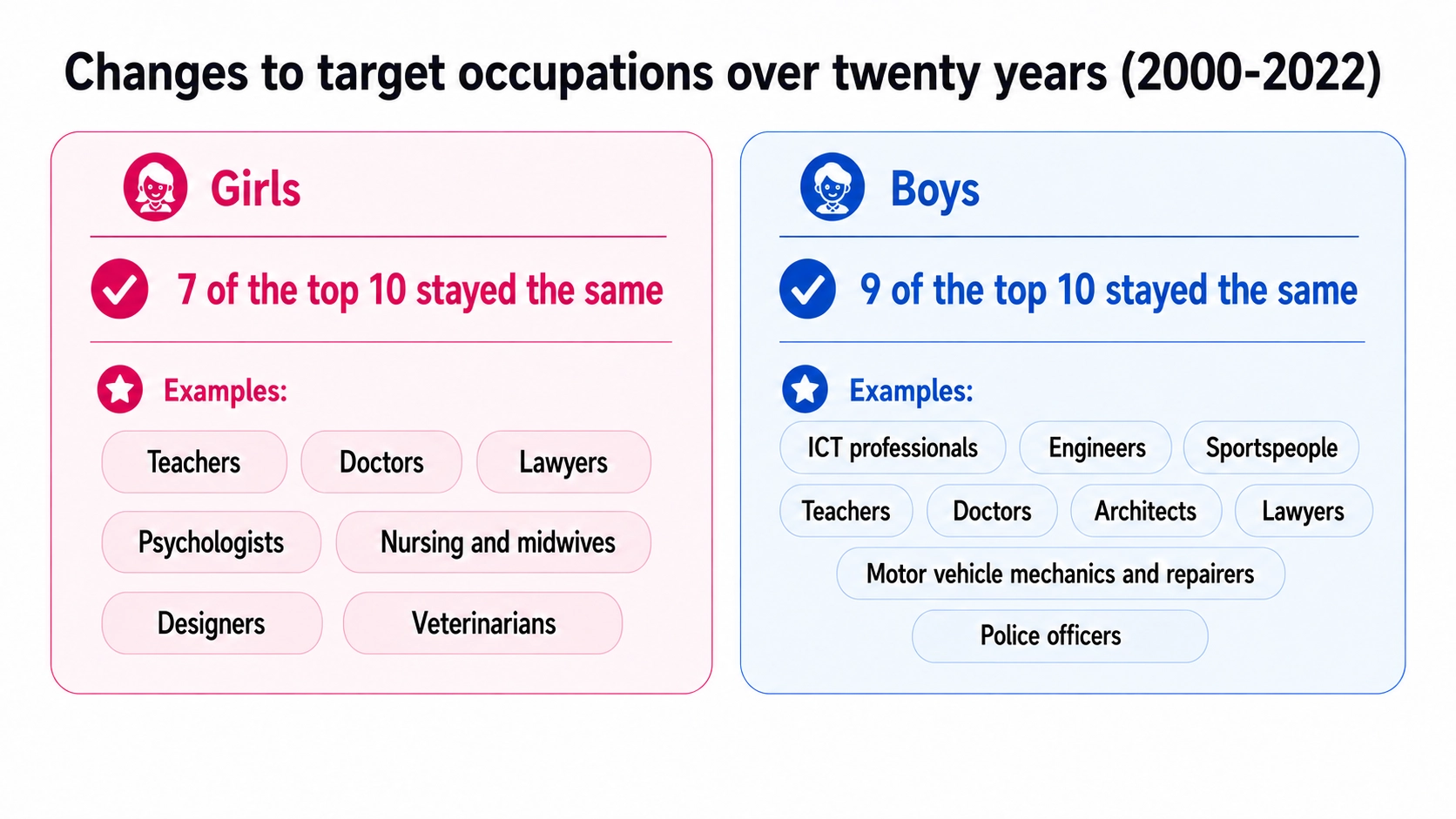
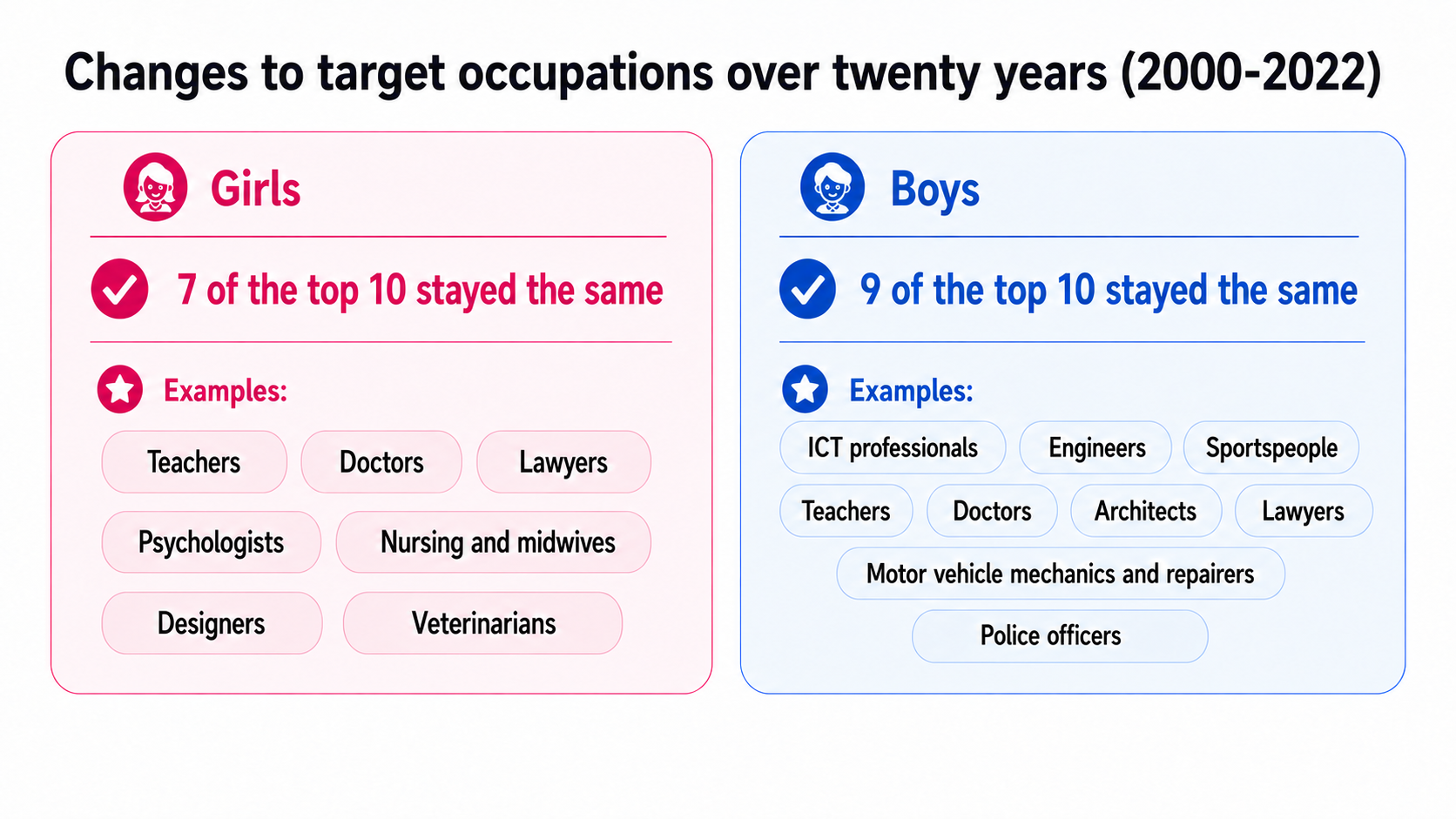
And although boys and girls shared some popular choices, including doctors, teachers and lawyers, it is interesting to see that as recently as 2022, familiar gender stereotypes were still reflected in the jobs teenagers imagined doing. Engineers and sportspeople featured prominently among boys’ answers, while nursing and veterinary work were among girls’ leading choices.
What is also striking is that although there are thousands of occupations, teenagers’ answers about their target careers were concentrated in remarkably few. Across OECD countries in 2022, just ten job titles accounted for half the careers girls reported aiming for. For boys, it was 44%, again, nearly half for their target careers.
In other words, among the students who named an occupation, around half of each gender reported they wanted to work in one of just ten jobs. Now that’s a lot of young people picturing themselves in a small corner of the working world.
The work we see – and the work we don’t
When you think about the working world teenagers can actually see, this concentrated and familiar shortlist starts to make some sense. They see teachers every school day. They visit doctors. They hear about the work their family and friends do. Television supplies a fairly dependable stream of lawyers, police officers and hospital staff – many of whom are doing their work in memorable or drama-filled settings.
But some work stays out of sight, even when teenagers use what it produces every day. Think of a phone app and all the work behind it – finding out what people need, designing how it looks, writing the code, testing it and keeping their information safe. There’s a whole range of jobs behind that one app, with different day-to-day activities, working environments and job titles.
So whilst the app is visible, those jobs are much less so.
Parents and family might be able to help teenagers discover some of that less visible work, but our own knowledge of the world of work has edges too. We know the parts of working life we’ve encountered.
But beyond that, we may be relying on the same familiar shortlist as everyone else.
Of course, wanting to be a teacher, a doctor or an engineer is a wonderful aspiration. The question is what else a teenager has had the chance to discover. What other work might appeal to them if they knew more about it?
Making the invisible visible
However, attempting to explore the thousands of occupations in the world of work without a guiding framework is a sure-fire way to lose the will to live.
We need more than a longer list of job titles. We need a way to make sense of the work behind them, so teenagers can move beyond the jobs they already know without having to explore everything at once.
That’s what we provide with the Work Sync work map and the videos that explain it. The map helps young people, and those supporting them, see the breadth of the working world – not just more job titles, but the different kinds of work people do. It gives them a way to make sense of that bigger picture and find places to explore. The videos bring those work activities to life, so they can picture what the work involves and respond to a simple question: ‘Does this work interest you?’
Think back to the app. A teenager might have little interest in writing code but be interested in finding out what people need to make life easier in the digital world, designing how it looks, or how to market it. Learning about the work itself can help them discover something that interests them in a part of the working world they might never have thought to explore.
We can’t know where that exploration will lead. But we can give young people a clearer picture of the working world as they begin to imagine their place in it.
References
OECD (2025), The State of Global Teenage Career Preparation, OECD Publishing, Paris, https://doi.org/10.1787/d5f8e3f2-en.